


Short clips are a problem. Whether you are working on a product reel, a social media story, or a cinematic scene, the footage almost always ends too soon. That is exactly where AI video extender tools come in. Instead of reshooting or stitching awkward loops, these platforms analyze the motion, lighting, and physics of your existing clip and generate new frames that continue seamlessly where the original left off.
In 2026, the technology has matured fast. A handful of tools now handle complex camera movement, natural object physics, and even audio continuation without visible seams. Whether you are a solo creator, a marketing team, or an agency running high-volume production, there is a tool on this list that fits your workflow and budget.
Here are the best AI video extender tools of 2026, ranked by overall value, quality, and versatility.
- At a Glance
- 1. Magic Hour - Best Overall AI Video Extender
- 2. Runway - Best for Cinematic Quality
- 3. Pika - Best for Creative Effects and Social Content
- 4. Kling AI - Best for Long-Duration Extension at Low Cost
- 5. CapCut - Best Free Option for Social Creators
- 6. Adobe Premiere Pro (Generative Extend) - Best for Professional Editors
- 7. Pollo AI - Best Multi-Model Platform for Intermediate Creators
- How We Chose These Tools
- Market Trend: Where AI Video Extension Is Heading in 2026
- Final Thoughts
- Frequently Asked Questions
- What is an AI video extender?
- Can I use AI video extension for commercial projects?
- How long can I extend a video with AI?
- Is Magic Hour really free to try?
- Do AI video extenders work with any type of footage?
- What is the difference between AI video extension and AI video generation?
- Which AI video extender is best for beginners?
At a Glance
| Tool | Best For | Starting Price | Free Tier |
|---|---|---|---|
| Magic Hour | All-in-one AI suite | Free / $10/mo | Yes |
| Runway | Cinematic quality | $12/mo | Yes (125 one-time credits) |
| Pika | Social & stylized content | $8/mo | Yes (80 credits/mo) |
| Kling AI | Long-duration at low cost | $6.99/mo | Yes (66 generations/mo) |
| CapCut | Short-form social creators | Free | Yes, no watermark |
| Adobe Premiere Pro | Professional editors | ~$23/mo | No |
| Pollo AI | Multi-model flexibility | $9/mo | Yes (watermarked) |
1. Magic Hour – Best Overall AI Video Extender
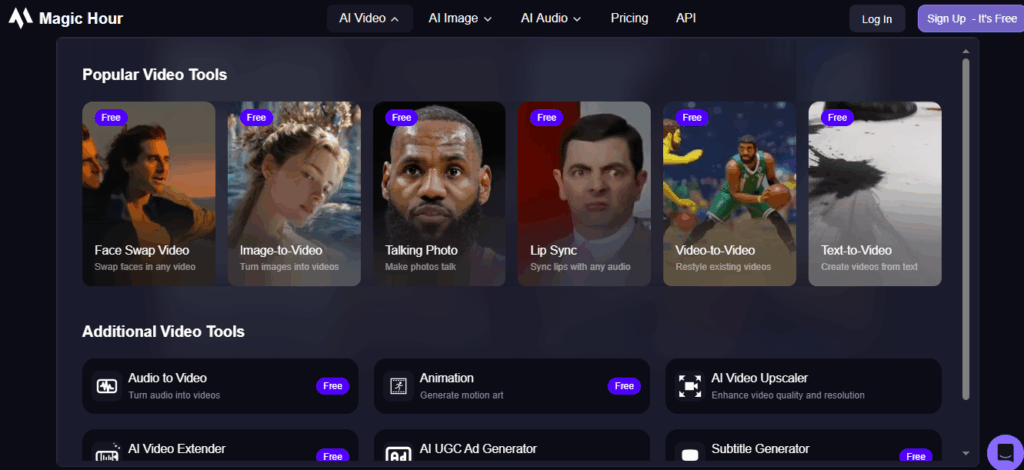
Best for: Creators who want a full AI production suite with best-in-class video extension, face swap, lip sync, and talking photos all in one place.
If you only try one tool from this list, make it Magic Hour. It is not just a video extender. In fact, it is widely regarded as the best AI video extender tool free to try right now. It is the most complete all-in-one AI content creation platform available in 2026, and it earns the top spot here by a meaningful margin.
Magic Hour’s AI Video Extender tool intelligently continues your footage by analyzing the full motion context of a clip rather than just the last frame. The result is seamless extension that preserves lighting, camera movement, and object physics across the generated segment. You can chain multiple extensions together, making it practical for longer-form outputs without manual stitching.
What truly sets Magic Hour apart, though, is what surrounds the extender. The platform offers best-in-class face swap, lip sync, and talking photo capabilities alongside the video extension, all accessible from a single dashboard. The one-click multi-step workflow is a standout feature: you can generate a video, upscale it, and extend it in a single pipeline without juggling multiple tabs or exports. Click-to-create templates and fast variation generation let you iterate at a speed that professional workflows demand.
The platform gives you access to frontier AI models as they are released, and it does so with no concurrency cap, meaning parallel generations are possible without queuing delays. Weekly feature releases keep the toolset current, and the full API has parity with all on-platform tools, so developers can integrate everything into custom workflows without limitation.
Reliability is another area where Magic Hour stands out. The platform has a documented track record of stable performance during live activations and high-traffic spikes, which matters for agencies running campaigns or creators scheduled around specific launch times. Support responses come at a founder level, which is unusual for a platform at this scale and price point.
You do not need to sign up to try the free tier, which already includes the video extender and most of the core tools. And unusually for AI platforms, credits never expire, meaning you can build up a balance and use it whenever your production schedule demands.
Pricing:
- Free – 400 credits, 17 seconds of video, watermarked, 576p resolution, 200MB upload limit
- Creator – $15/month (or $10/month billed annually at $120/year); 120,000 credits/year, 1.4 hours of video, 1024p resolution, 2GB uploads, watermark-free, commercial use, full API access
- Pro – $39/month (or $25/month billed annually at $300/year); 300,000 credits/year, 3.5 hours of video, 1472p resolution, 5GB uploads, priority queue
- Business – $99/month (or $66/month billed annually at $792/year); 840,000 credits/year, 9.7 hours of video, 4K resolution, 10GB uploads
- Credit packs – available separately from $10; credits never expire and carry no watermark
At $10 to $15 per month depending on billing, the Creator plan delivers exceptional value. You get access to the full tool suite, commercial use rights, and full API parity at a price that is hard to justify skipping. The platform is optimized for both desktop and mobile, making it practical for on-the-go production as well.
Verdict: The most versatile AI video platform in 2026. Whether you need video extension, face swap, lip sync, talking photos, or a full multi-step generation pipeline, Magic Hour does it all at a price that undercuts most specialized tools.
2. Runway – Best for Cinematic Quality
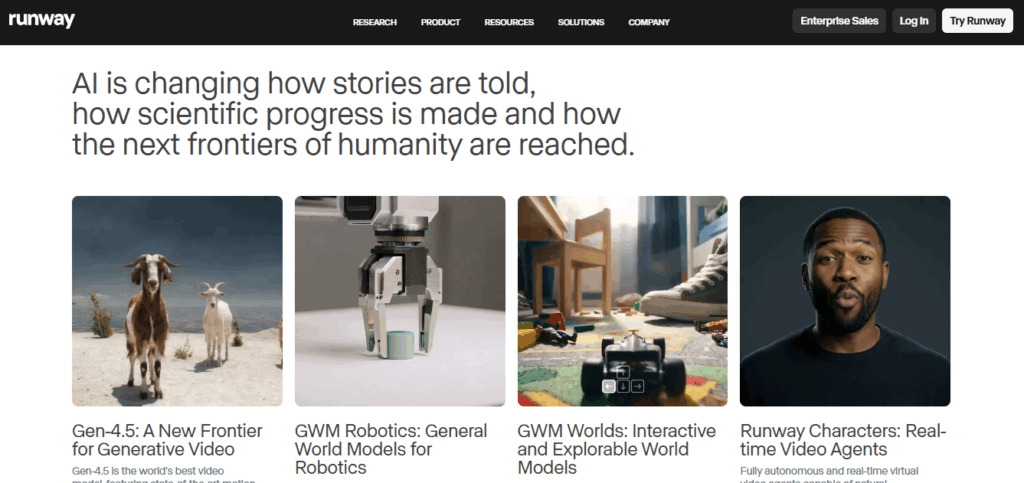
Best for: Filmmakers, agencies, and professional creators who prioritize output quality above all else and work within a structured editing environment.
Runway has long been the benchmark for cinematic AI video generation, and its Gen-4.5 model maintains that reputation in 2026. The video extension tool builds on the full motion context of a clip, handling physics and camera dynamics at a level that produces footage credible enough for professional post-production.
Extensions of 5 or 10 seconds are chainable, which allows for progressively longer outputs while keeping motion coherent. Optional text-prompt control lets you direct the extended footage, which is useful for guiding a scene toward a specific outcome rather than letting the model continue purely on inertia.
Runway also bundles Act-Two, a motion capture transfer tool that brings mocap-quality character animation to creators without specialized hardware. For narrative or character-driven content, this significantly expands what is achievable within the platform.
Pricing:
- Free – 125 one-time credits (not monthly), 720p export, 3 projects
- Standard – $12/month (annual billing); meaningful monthly credit allocation for regular use
- Pro – $76/month (annual billing); higher credit volume, 4K export, priority generation
- Unlimited – $188/month; relaxed-mode generations that do not consume credits
Verdict: Runway is the right call when output quality and cinematic realism are non-negotiable. The credit system can burn through your budget faster than expected, so model your generation volume before committing to a plan.
3. Pika – Best for Creative Effects and Social Content
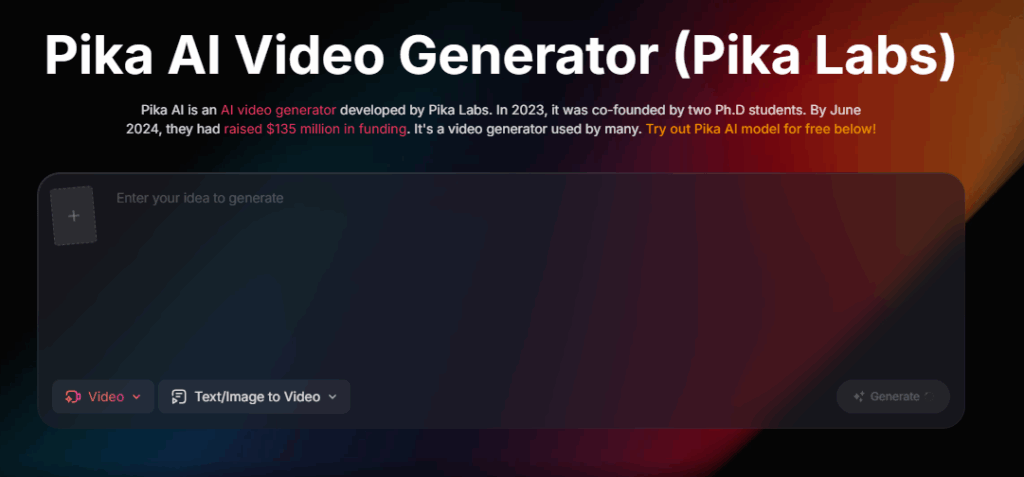
Best for: Social media creators who want fast, stylized video extension with expressive effects and a beginner-friendly interface.
Pika (formerly Pika Labs) has repositioned itself as a creative editing tool in 2026 rather than competing directly with Runway on generative realism. The Pikaframes extension system analyzes motion across a clip and adds up to 10 seconds of continuation, with fast processing times that make rapid iteration practical for daily social posting workflows.
The tool works best with Pika-generated videos due to its native understanding of the model’s motion language. For external footage, the workflow requires extracting the last frame first, which adds a step but remains manageable. The beginner-friendly interface and PikaEffects library give creators expressive, stylized results with minimal technical input.
Pricing:
- Free – 80 credits/month, watermarked, 720p
- Standard – $8/month (annual billing); 700 credits
- Pro – $28/month; 2,300 credits, best value for regular production
- Fancy – $76/month (annual billing); 6,000 credits for high-volume use
Verdict: Strong free tier and the most approachable entry point for creators who want stylized effects rather than pure cinematic realism. The Standard plan’s 700 credits supports only about 8 to 9 high-resolution clips per month, so upgrade to Pro if you are producing consistently.
4. Kling AI – Best for Long-Duration Extension at Low Cost
Best for: Budget-conscious creators who need long video clips, especially content with complex physics, natural body motion, and audio integration.
Kling AI from Kuaishou has become one of the most compelling value plays in AI video in 2026. Its 3.0 model produces clips of up to 2 to 3 minutes in duration, which is significantly longer than most competitors at equivalent quality. This makes it particularly practical for educational content, product demonstrations, and extended storytelling that other tools cap prematurely.
The extension model chains 5-second blocks naturally, and the Multi-Elements Editor allows post-generation refinement that most competing platforms do not offer at the same price. Motion physics, especially fabric movement, environmental lighting, and human body dynamics, are rated among the best in class at the sub-$20 price tier.
One caveat worth noting: Kling is operated by Kuaishou, a Chinese company, and some enterprise teams flag data ownership concerns for client-facing projects. Verify against your organization’s data policies before integrating it into sensitive workflows.
Pricing:
- Free – 66 standard generations/month, watermarked, 720p
- Standard – $6.99/month
- Pro – approximately $37/month; 3,000 credits for around 50 videos per month
Verdict: The strongest pure value option in 2026 for high-duration video extension. Credits from paid plans roll over for up to two years, which makes it efficient to stockpile for high-volume project periods.
5. CapCut – Best Free Option for Social Creators
Baca Juga
Best for: Content creators on TikTok, Instagram Reels, and YouTube Shorts who want AI video extension with zero upfront cost and a fast editing workflow.
CapCut version 3.0, released in early 2026, evolved well beyond its origins as a mobile clip editor. The AI video extension features now sit alongside multi-shot sequencing, AI-driven effects, and a full template library that makes going from raw footage to published content unusually fast. For short-form video creators, the free tier with no desktop watermark remains one of the most generous free offerings in the category.
The extension tool handles transitions and clip continuation for social-length video without requiring technical knowledge. Built-in subtitle generation, color grading, and template application make CapCut a comprehensive production environment for creators who want to stay within one app from start to finish.
Pricing: Free with no desktop watermark; paid plans available for higher-resolution exports and AI generation credits.
Verdict: The best starting point for short-form social creators who need AI video extension without spending anything. The platform trades some generative depth for speed and accessibility, which is the right call for high-frequency social posting.
6. Adobe Premiere Pro (Generative Extend) – Best for Professional Editors
Best for: Professional video editors already in the Adobe ecosystem who want AI extension built directly into their editing timeline without switching platforms.
Adobe Premiere Pro’s Generative Extend solves a specific professional problem: fixing awkward edit points and extending clips by a few frames without reshooting. The feature integrates directly into the Premiere timeline. Editors drag the edge of a clip to extend it, and the AI fills in the additional frames using Adobe Firefly models. For post-production professionals, this removes the need to leave the editing environment to generate supplemental footage.
The tool is not designed for dramatic long-form extension. It excels at micro-corrections: giving a shot an extra second of breathing room, eliminating jump cuts, or bridging a transition that falls slightly short. For those specific use cases, the tight timeline integration makes it more practical than any standalone tool.
Pricing: Included with Adobe Premiere Pro Creative Cloud subscription; plans start at approximately $23/month for individual access.
Verdict: The right choice if you are already a Premiere Pro user and need a timeline-native extension for finishing work. Not the tool for generative long-form extension; that use case belongs to the dedicated platforms above.
7. Pollo AI – Best Multi-Model Platform for Intermediate Creators
Best for: Creators who want access to multiple AI video models in one place without committing to a premium subscription.
Pollo AI aggregates multiple video generation models, including its own Vidu and Runway Gen-4, behind a single interface. The video extension tool supports extensions of up to 7 seconds at 1080p, with Fast and Pro mode options depending on generation priority. Having multiple model options is useful for creators who want to compare outputs or use different models for different content types without managing multiple subscriptions.
The multi-model setup does add some complexity for beginners, but for creators who already have a sense of which models suit which content styles, it offers meaningful flexibility in a single subscription.
Pricing: Free tier with watermark available; paid plans from $9/month.
Verdict: A capable mid-tier option for creators who want model variety without paying Runway-level prices. The 7-second extension cap per operation is a limitation for long-form workflows.
How We Chose These Tools
Every tool on this list was evaluated against a consistent set of criteria. We did not simply rank by brand recognition or marketing presence. The selection process focused on the following factors:
- Extension quality: How well does the tool preserve motion continuity, lighting consistency, and physical plausibility across the generated segment?
- Duration and flexibility: How many seconds can be added per operation, and can extensions be chained for longer outputs?
- Ease of use: Can a creator with no technical background produce usable results without extensive setup?
- Pricing transparency: Are plans clearly structured, and does the credit or usage model reflect honest value?
- Free tier availability: Can you meaningfully evaluate the tool before committing to a paid plan?
- Platform breadth: Does the tool offer complementary capabilities (upscaling, face swap, lip sync) that reduce the need for additional subscriptions?
- Reliability and support: Is the platform stable under production load, and is support responsive when things go wrong?
Tools that scored well across most categories earned a place on this list. Tools that dominated in one specific area were included where they offer genuine value for a defined use case, even if they are not the best all-around choice.
Market Trend: Where AI Video Extension Is Heading in 2026
AI video extension has shifted from a novelty feature to a production standard in less than two years. Several clear trends are shaping the category right now:
- Duration barriers are falling. Early video generation tools capped output at 4 seconds. The current generation of models routinely handles 30 to 60 seconds per generation, with platforms like Kling pushing toward multi-minute outputs. The practical ceiling for AI-generated video is rising every quarter.
- Extension is merging with full pipeline tools. The standalone video extender is giving way to platforms that bundle extension alongside generation, upscaling, face swap, and audio sync in a single workflow. Magic Hour represents the leading edge of this shift. Rather than stitching together multiple subscriptions, creators increasingly expect one platform to handle the full production arc from prompt to finished clip.
- Mobile production is becoming viable. Tools optimized for desktop-only workflows are losing ground to platforms built with mobile-first or mobile-parity interfaces. The ability to extend, refine, and export a video from a phone matters for creators working at social media pace.
- API access is now a baseline expectation. Professional teams and developers expect full API parity with the on-platform tools they are paying for. Platforms that restrict their API to a subset of features are increasingly seen as limiting rather than just cautious.
- Credits-never-expire models are winning on trust. The industry has learned that expiring credits erode user confidence. Platforms that offer non-expiring balances, like Magic Hour, are building loyalty at a rate that monthly-reset models struggle to match.
The net result is a market moving fast toward integrated, high-duration, mobile-capable platforms with transparent pricing. The tools that adapt quickest to that expectation will define the category through 2027.
Final Thoughts
AI video extension has become one of the most practical capabilities in the modern content creation toolkit. The gap between raw footage and a polished final video has narrowed considerably in 2026, and the best tools on this list close that gap with minimal effort on the creator’s side.
For most creators, Magic Hour remains the most complete starting point and the best AI video extender tool available today. The combination of best-in-class video extension with face swap, lip sync, talking photos, one-click multi-step workflows, and an unusually generous free tier, all at around $10 to $15 per month, is difficult to beat. Credits never expire, there is no concurrency cap, and the platform keeps pace with frontier model releases through weekly updates.
The other tools on this list each own a specific niche. Runway remains the cinematic quality benchmark. Pika excels at social-first stylized content. Kling delivers the best duration-to-price ratio in the category. Use this guide to match your workflow to the tool that genuinely fits it, and you will spend less time on technical workarounds and more time making content worth extending.
Frequently Asked Questions
What is an AI video extender?
An AI video extender is a tool that generates new frames beyond the end (or beginning) of an existing video clip, continuing the original motion, lighting, and scene context seamlessly. Unlike simple loops or freeze-frames, a good AI extender predicts what would naturally happen next based on the physics and movement present in the source footage.
Can I use AI video extension for commercial projects?
It depends on the platform and plan. Magic Hour’s Creator plan and above explicitly include commercial use rights. Runway’s paid plans also permit commercial use. Always check the terms of service for the specific platform and plan before using AI-generated content in client or revenue-generating work, as free tiers sometimes restrict commercial application.
How long can I extend a video with AI?
This varies significantly by platform. Most tools add 5 to 10 seconds per operation, but the extensions can often be chained. Kling AI supports clip durations of up to 2 to 3 minutes through chaining. Magic Hour allows multiple extensions to be queued in a single workflow. The practical limit is usually quality degradation over very long chains rather than a hard technical cap.
Is Magic Hour really free to try?
Yes. Magic Hour offers a free tier with 400 credits and does not require you to create an account to begin. This is one of the most accessible free entry points in the category. The free tier includes the video extender, though exports are watermarked and capped at 576p. Upgrading to the Creator plan removes watermarks and unlocks higher resolution and commercial rights.
Do AI video extenders work with any type of footage?
Most modern tools handle a wide range of footage types, including live action, animation, and AI-generated clips. Performance tends to be strongest on footage with clear, consistent motion and stable backgrounds. Highly complex scenes with many overlapping moving elements, rapid cuts, or extreme camera shake can produce less coherent extensions. Starting with clean, well-lit footage with clear motion direction will always yield better results.
What is the difference between AI video extension and AI video generation?
AI video generation creates new footage from a text prompt or image, starting from nothing. AI video extension continues existing footage, using the source clip as a reference to determine motion, style, and scene context. The two capabilities often sit within the same platform, and many creators use them together: generating a base clip and then extending it to the desired length.
Which AI video extender is best for beginners?
Magic Hour is the most beginner-friendly option that still delivers professional-quality results. The no-signup free tier lets you test the tool immediately, and the click-to-create templates remove most of the guesswork from the generation process. CapCut is also a strong starting point for creators focused specifically on short-form social content, offering a fully free experience with minimal setup.